Gujarat is not just riding the wave of the blue economy but leading it. The state is emerging as a powerhouse in India’s blue economy. Its recent achievement of over 10.42 lakh metric tonnes of annual fish production is a defining milestone.
This is not just a number, it’s a signal of how Gujarat is strategically leveraging its long coastline. Along with marine resources, and forward-looking policies to drive economic growth, social upliftment, and sustainable development.
With a coastline stretching more than 2,340 kilometers, Gujarat is uniquely positioned among Indian states to harness marine potential. This gives the state a natural advantage: access to abundant marine life, opportunities for aquaculture, and scope for fishing infrastructure development.
As part of the blue economy, Gujarat’s maritime strength is not just about harvesting fish. It’s about transforming that potential into a vibrant economic sector.
Record Fish Production: A Growth Engine
In 2024–25, Gujarat recorded 10.42 lakh MT of fish production. It is a combination of 7.64 lakh MT from marine sources and 2.78 lakh MT from inland fisheries. This marks a strong upward trajectory: the previous years’ average was over 9.30 lakh MT annually. For 2025–26, the target is even more ambitious, over 11 lakh metric tonnes.
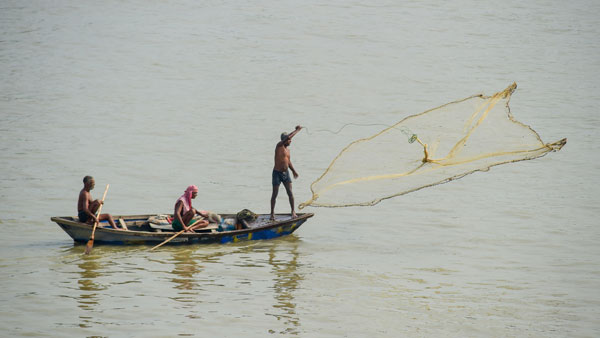
This scale of production is not just about volume, it’s a major economic lever. Higher fish yields translate into more income for fishermen, more raw material for processing units, and more exports.
Gujarat’s seafood includes shrimp, ribbonfish, cuttlefish, and squid. It is in high demand across global markets such as China, Europe, the US, and Japan. The export opportunity boosts foreign exchange earnings for the state and reinforces Gujarat’s role as a seafood export hub.
Policy Support & Infrastructure Strengthening
Gujarat’s blue economy success isn’t accidental. It’s backed by concerted policy support, both from the state and the central government. Under the Pradhan Mantri Matsya Sampada Yojana (PMMSY), Gujarat has secured INR 897.54 crore worth of project approvals between 2020–21 and 2024–25. For the fiscal year 2025–26, an additional INR 50 crore has been earmarked for the state.
But beyond funding, Gujarat is making smart, targeted interventions. It has reduced VAT on diesel used in fishing. It is giving subsidies for kerosene and petrol, to lower fuel costs for fishermen. Land is being allotted for shrimp farming, and facilities like roads and electricity are being improved around fishing villages. Crucially, four new fishing harbors are under development in Madhwad, Nava Bandar, Veraval-2 and Sutrapada to improve landing and handling infrastructure for small-scale fishermen.
In addition, the state is promoting modern aquaculture and value-addition. Support is being offered for Biofloc systems / Recirculating Aquaculture Systems (RAS) to boost productivity.
There is financial assistance for shrimp pond preparation, including medicine, minerals, and probiotics. The government is also backing cage culture (locally called Bhambharapani), which can increase yield per unit water area.
Infrastructure building includes boat-building yards, cold storage, and blast freezer units which is critical for reducing post-harvest losses. There is also support to set up fish by-product processing units, seaweed seed banks, and hatcheries for shrimp, crab, and fish.
These are not just incremental upgrades: they represent a holistic development of the fisheries value chain, from catching to processing to export, and they make the sector more resilient, efficient, and sustainable.
Socio-Economic Impact: Livelihoods and Inclusive Growth
Gujarat’s blue economy boom is deeply linked to improving the lives of coastal communities. Fishing has traditionally been a livelihood for thousands of families in Gujarat. With higher production, better infrastructure, and government support, these communities are seeing real economic benefits.
Improved earnings from fishing and aquaculture help reduce poverty, while subsidised fuel and upgraded harbors lower the operational burden on fishermen. Modern aquaculture methods offer better, more stable yields. Infrastructure investments like cold storage prevent spoilage, ensuring that more of the catch reaches markets in fresh, export-ready condition.
By boosting processing capacity and by-product utilization (e.g., seaweed, fish waste), Gujarat is also creating ancillary industries. These ancillary industries mean more jobs. Not just for fishermen, but for people in transport, cold chain logistics, processing, and even research. In turn, this helps coastal communities diversify income sources, making them less vulnerable to fishing shocks and more integrated into the formal economy.
Conclusion
Gujarat’s landmark 10.42 lakh MT annual fish production is more than a statistic. It is a powerful indicator that the state is successfully harnessing the blue economy to drive inclusive, sustainable, and high-impact development. With its long coastline, backed by strong policy thrust and smart infrastructure, Gujarat is turning marine potential into real economic value.
As it scales to 11 lakh MT and beyond, the benefits will be manifold: stronger coastal livelihoods, export-led growth, environmental sustainability, and regional development. If you like to enlighten yourself with stories from various sectors, then stay tuned with us at Gujpreneur!