
Growth changes a business.
More people. More responsibilities. More locations. More stakeholders. More decisions.
But beyond a certain point, growth demands something more fundamental: an organisation strong enough to sustain it.
That is the larger mandate behind Kartik Pandya’s next step at Felix Industries and Group Companies, where he has taken on the role of Group General Manager – Corporate Affairs, Human Resources & Administration.
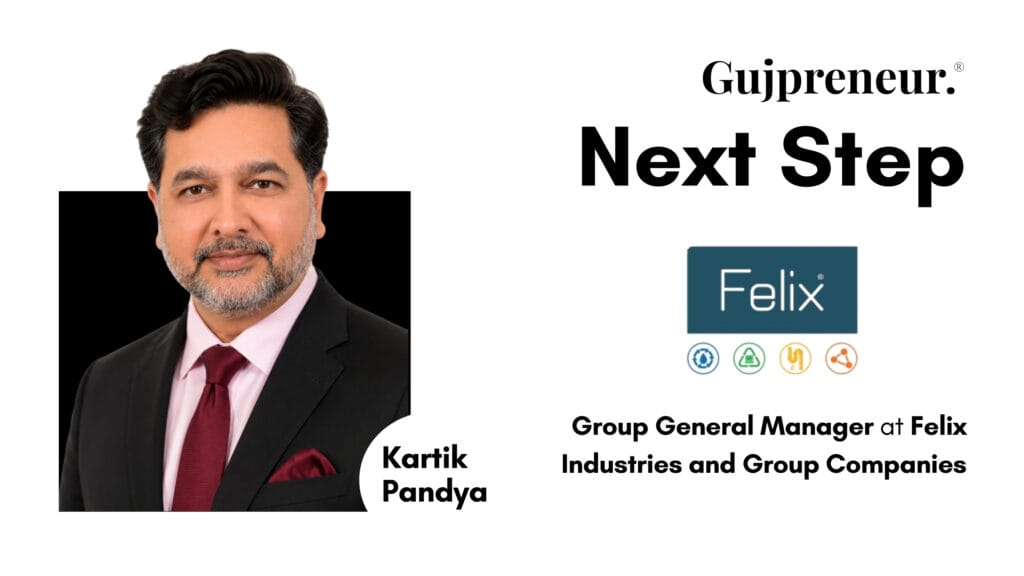
The appointment brings together people, administration, operations, stakeholder coordination and institution-building — areas that have shaped Kartik’s professional journey across different business environments.
But for him, the significance of this move goes beyond the designation.
“At this stage of my career, the significance of a role lies less in the designation and more in the mandate behind it.”
Felix Industries operates across multiple businesses, with the Managing Director’s vision clearly focused on expanding the Group’s business footprint and capabilities. The Group dimension makes the mandate particularly interesting, because the objective is not to make every business identical, but to identify where common standards, shared practices and stronger coordination can create value while preserving the individual character and operating needs of each business.
As the organisation expands, the question is no longer simply how to grow, but how to strengthen the institutional foundation that can support that growth sustainably.
Having recently taken over the responsibilities, he is first looking to understand the businesses, engage with people across functions and locations, recognise the strengths already in place and identify where greater alignment can create value.
“I see the role not as an invitation to change things quickly, but to understand carefully and then help strengthen what will support the Group’s next stage of growth.”

Scaling Without Losing Agility
For growing companies, expansion can often outpace the systems and structures that support it.
Kartik identifies this as one of the recurring organisational challenges businesses encounter as they scale:
“As businesses scale, growth can sometimes move faster than the systems and structures supporting it.”
What works when decisions are concentrated among a small group of people may become difficult to sustain when teams, locations, responsibilities and stakeholder expectations multiply.
The answer, however, is not to build layers of bureaucracy.
For Kartik, organisational maturity means creating clarity without complexity — clear roles, stronger leadership depth, accountability and systems that allow people to make decisions effectively.
“Good systems should simplify work, not create bureaucracy.”
That philosophy becomes particularly relevant as organisations attempt to scale while remaining agile.
The New Role of HR, Administration and Corporate Affairs
The functions under Kartik’s mandate are also changing. HR today is no longer limited to recruitment, payroll and policies. It increasingly influences organisation design, leadership capability, performance culture, succession and workforce readiness. Administration goes beyond coordination and facilities to influence operational continuity, cost discipline, safety, productivity and employee experience.
Corporate Affairs, meanwhile, plays a critical role in institutional relationships, reputation, external interfaces and stakeholder confidence. The opportunity lies in bringing these functions together around one larger business objective.
“When Corporate Affairs, HR and Administration work as a connected leadership agenda, they can create the organisational conditions in which business teams perform better.”
For Kartik, the effectiveness of these functions cannot be measured simply by the number of policies created or processes implemented. It should be visible in how the organisation operates.
“The measure is whether people have greater clarity, leaders have better support, decisions move faster with appropriate accountability, and the organisation becomes easier to scale.”
That is a significant shift in perspective: from support functions to organisational infrastructure.
Building Systems Without Losing the Entrepreneurial Edge
In these initial weeks at Felix Industries and its group companies, Kartik’s focus is on understanding where greater consistency can add value without taking away the flexibility that individual businesses require.
Among the areas he is beginning to examine are role and decision clarity, a more consistent review and MIS cadence, manpower and capability mapping, group-wide policies where commonality creates value, and stronger coordination across functions and companies.
But perhaps one of the most important priorities is leadership depth. As organisations grow, leadership responsibility also needs to broaden. Developing a strong second line helps distribute responsibility, accelerate decision-making and build greater organisational resilience. A stronger second line of leadership creates distributed responsibility, faster decision-making and greater organisational resilience.
Communication plays an equally important role. When priorities are clear, information is accessible and people understand how their responsibilities connect with the larger business, alignment becomes stronger.
Measuring the Next Chapter by What Remains
For Kartik, the ultimate measure of this new chapter will not be the title attached to it. It will be the capabilities, systems and culture that continue to create value.
“I would like this chapter to be remembered for institution-building. A designation is temporary; the systems, capabilities and culture that remain after a leadership tenure are a more meaningful measure of contribution.”
That philosophy makes this Next Step relevant beyond one individual appointment. For a growing business group, organisational strength is not separate from business growth. It is what allows growth to become sustainable.
The challenge is to create a common organisational backbone without making every business operate identically; to strengthen governance without slowing decisions; to develop people without losing entrepreneurial energy; and to introduce systems that create clarity rather than complexity.
Kartik enters this chapter with the experience of different institutional and business environments, but also with an emphasis on learning the new context before attempting to reshape it.
“I want to combine the benefit of my past experience with the humility required to understand what is already working well here.”
Ultimately, his ambition is not simply to manage functions. It is to help build an organisation where people know what is expected, leaders are equipped to lead, information supports decisions, processes enable rather than obstruct, and businesses can grow on a stronger institutional foundation.
And that is what makes Kartik Pandya’s next step at Felix Industries more than a change in designation.
It is a move towards strengthening what every growing business increasingly needs – the organisational capability to turn expansion into enduring growth.
For more leadership movements, business stories, and insights shaping Gujarat and beyond, follow Gujpreneur.
