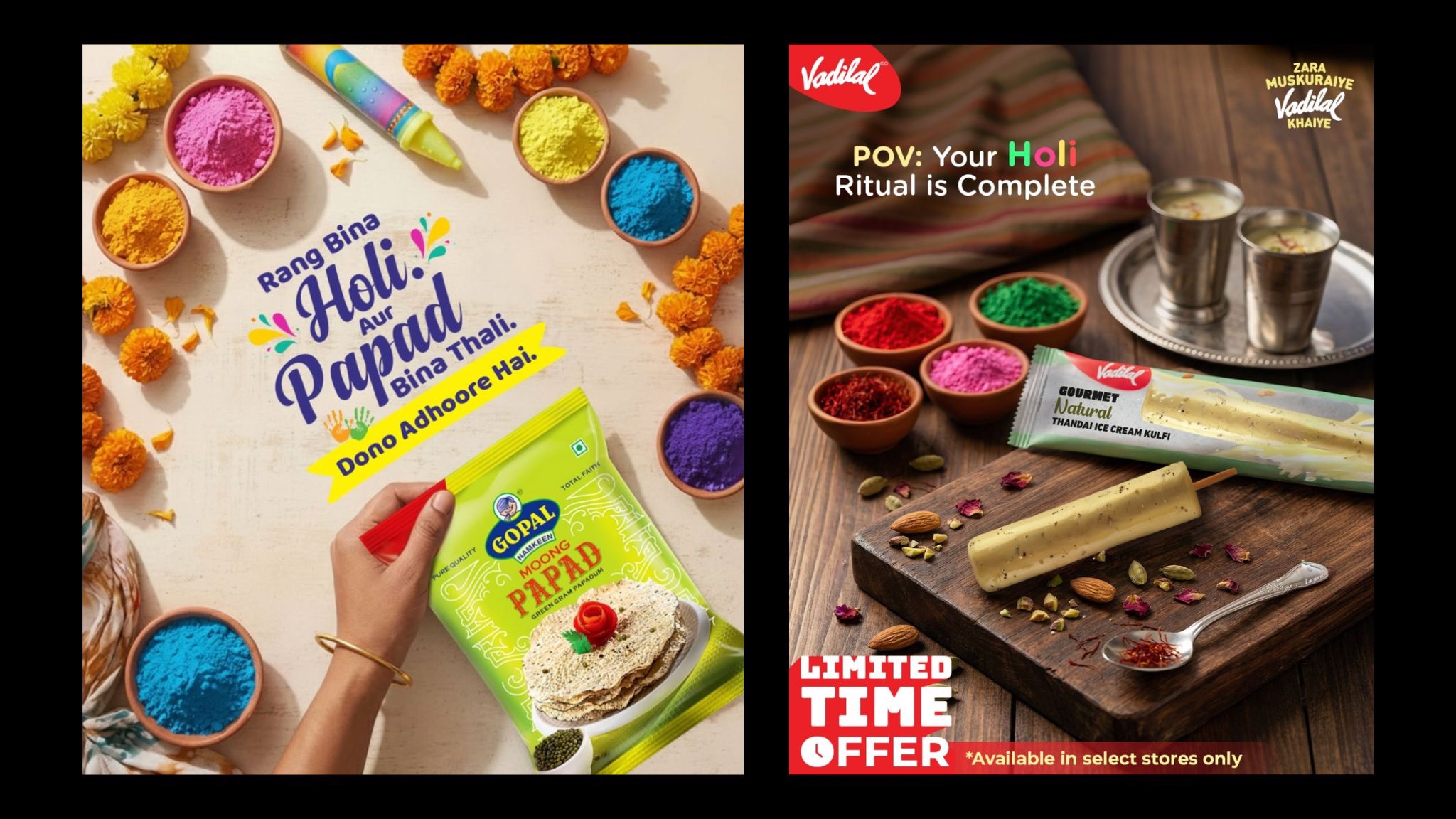
Every year, Holi transforms India into a canvas of colour, emotion, and celebration. But for Gujarat’s FMCG giants. Holi is more than a cultural moment – it is a high-impact conversion window. Behind every vibrant creatives lies structured strategy. Brands such as Vadilal, Gopal Snacks, and Amul don’t simply post festive greetings; they activate seasonal; demand psychology. Holi becomes a short-term demand accelerator where emotion meets execution, and celebration meets structured revenue planning.
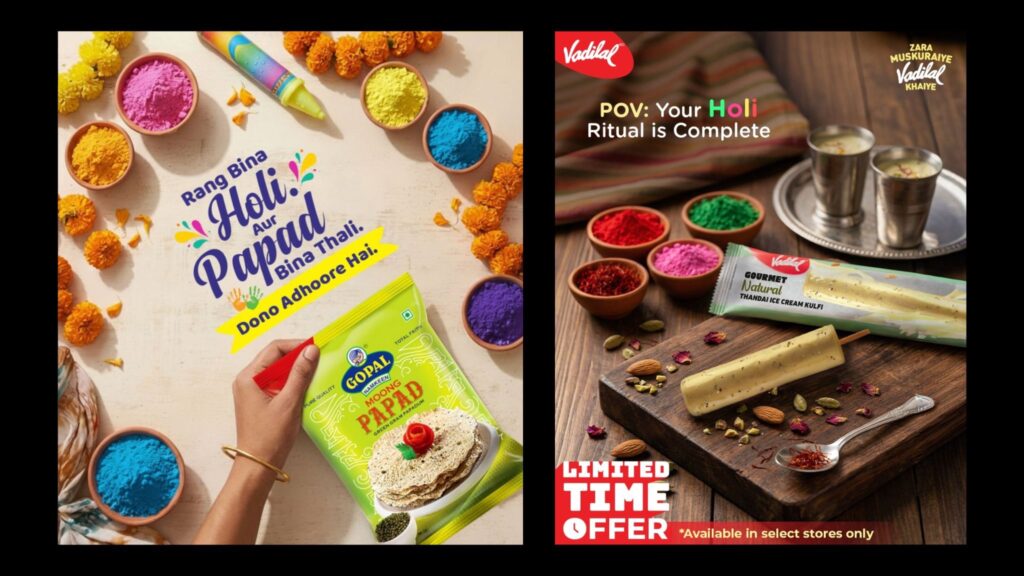
Limited Edition Psychology: Scarcity Drives Impulse
Seasonal launches during Holi are rarely accidental. When brands promote limited-time festive flavours or special packaging, they tap into scarcity psychology – one of the most powerful drivers of impulse buying.Limited editions create urgency, and urgency reduces decision hesitation. During festivals, consumers are already in an experimental mindset, making them more open to trying new variants without long-term commitment.
This temporary innovation model allows brands to test flavours, packaging, and pricing strategies with minimal long term risk. Holi becomes a live experimentation tab where companies gather real-time consumer feedback while increasing average basket size. Scarcity doesn’t just create buzz – it drives measurable conversion spikes and short-term revenue lifts.
Colour as a Conversion Device
Holi is built on colour, and smart brands translate that into visual marketing dominance. Bright powders, festive backdrops, and high-saturation creatives are not decorative choices – they are emotional triggers designed to boost brand recall and engagement. Colour enhances memory retention and strengthens emotional association with products.
For example, brands like Gopal Snacks integrate traditional festivals cues such as gulal, marigolds, and celebratory dining setups to embed their product into ritual settings. When snacks become part of celebration imagery, they shift from being commodities to becoming cultural participants. This contextual embedding reduces substitution risk and strengthens long-term brands memory.
Occasion-Based Positioning: From Product to Participation
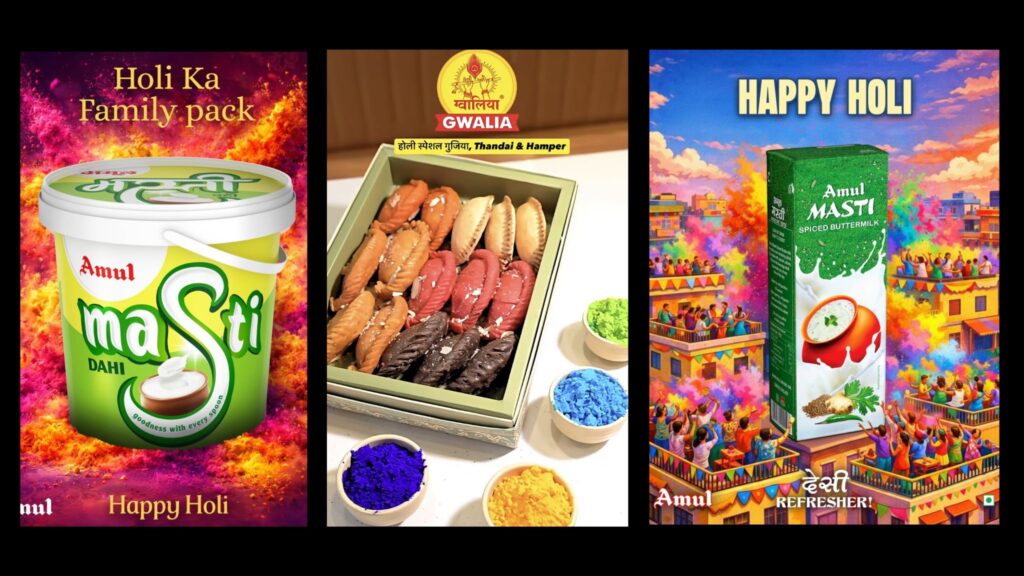
Successful Holi marketing shifts positioning from product selling to participation enabling. During festivals, consumers don’t just buy items — they buy experiences. Amul, for instance, repositions its beverages and dairy products as refreshment relief during Holi’s high-energy celebrations. Instead of marketing just dairy, the brand aligns with physiological needs such as hydration, cooling, and family sharing.
This occasion-based positioning allows brands to enter natural consumption moments. When a product becomes a solution within celebration rituals, price sensitivity decreases and premium perception strengthens. Participation-driven branding builds stronger long-term loyalty than purely transactional advertising.
Emotional Volume vs Media Spend
Holi campaigns often outperform regular promotions because emotional amplification replaces heavy media spending. Festivals naturally increase social sharing behaviour. Consumers generate celebration content organically, and brands integrate themselves into that cultural wave.
When creatives are culturally aligned and visually striking, users voluntarily amplify them. This reduces cost per impression while increasing engagement rates. Holi becomes a high efficiency marketing environment where emotional momentum enhances visibility without proportionally increasing advertising budgets.
The Distributor Advantage in Gujarat
Gujarat’s FMCG ecosystem is deeply distributor-driven, and festivals activate this network aggressively. During Holi, retailers prioritise combo packs, limited editions, and high-margin products. Shelf visibility becomes competitive theatre, especially in neighbourhood kirana stores and regional chains.
Brands that align inventory planning with festive demand gain stronger counter presence. Execution discipline — timely supply, retailer communication, and promotional material readiness — often determines success more than creative brilliance. In a retail-dominated market like Gujarat, operational preparedness becomes a decisive marketing advantage.
Packaging as Performance Media
During high-noise festive seasons, packaging becomes silent advertising. Temporary design enhancements, vibrant typography, and celebratory visual elements transform products into performance media. Retail shelves effectively become Instagram-ready backdrops.
When packaging itself commands attention, dependency on external advertising reduces. Consumers visually interact with the product before purchase, increasing impulse probability. In crowded markets, packaging differentiation directly impacts festive sales performance.
Cross-Category Consumption Clusters
Holi offers measurable marketing insights. Brands observe:
• Flavour experimentation rate
• Combo purchase trends
• Geo-specific demand spikes
• Retailer restocking velocity
This data informs summer campaign strategy. Festival analytics feed annual forecasting and Holi becomes a live behavioural dashboard. Holi rarely triggers single-product purchases. Snacks, sweets, beverages, and dairy move together. This creates cross-category bundling opportunities. Collaborative retail placements increase basket size. Integrated consumption thinking increases revenue density per customer. Festival marketing must consider cluster behaviour.
What Gujarat SMEs Can Learn
Small and mid-sized enterprises often underestimate the commercial potential of festivals. Instead of limiting communication to greetings, SMEs can introduce limited variants, create bundled offers, leverage WhatsApp retail networks, and use scarcity messaging to stimulate demand.
Even modest festive experimentation can yield valuable sales insights. Festival marketing, when approached strategically, becomes revenue engineering rather than decorative branding. Planning ahead of distributor cycles and aligning supply chains with demand spikes can significantly increase seasonal revenue impact.
Key Lessons for Entrepreneurs and Marketers
For readers of Gujpreneur, the larger takeaway is clear: festivals are not marketing interruptions — they are economic accelerators. Successful brands prepare weeks in advance, align supply chains with storytelling, and use emotional intensity to drive rational outcomes.
Entrepreneurs should treat every major festival as a mini financial quarter. Plan limited offers, build urgency, design culturally resonant creatives, ensure retail execution, and track post-festival data carefully. Emotional marketing without operational discipline fails. Operational strength without emotional storytelling underperforms.
The winning formula lies in synchronisation — culture, commerce, creativity, and conversion working together.
Holi is not merely a greeting opportunity. It is a conversion window. And the brands that approach it with strategy rather than sentiment consistently outperform the rest.