When vision meets velocity, transformation follows — and Gujarat is proving it. Gujarat is proving this with one of India’s most ambitious infrastructure expansions. The state is moving ahead with high-speed rail, modern metro networks, and the world’s largest green energy park. Combined, these initiatives are creating a Gujarat of the future which is fast, sustainable and ready. As a result, investors, entrepreneurs, and planners now see the state as a blueprint for next-generation development.
High-Speed Rail: Connecting Cities, Accelerating Economies
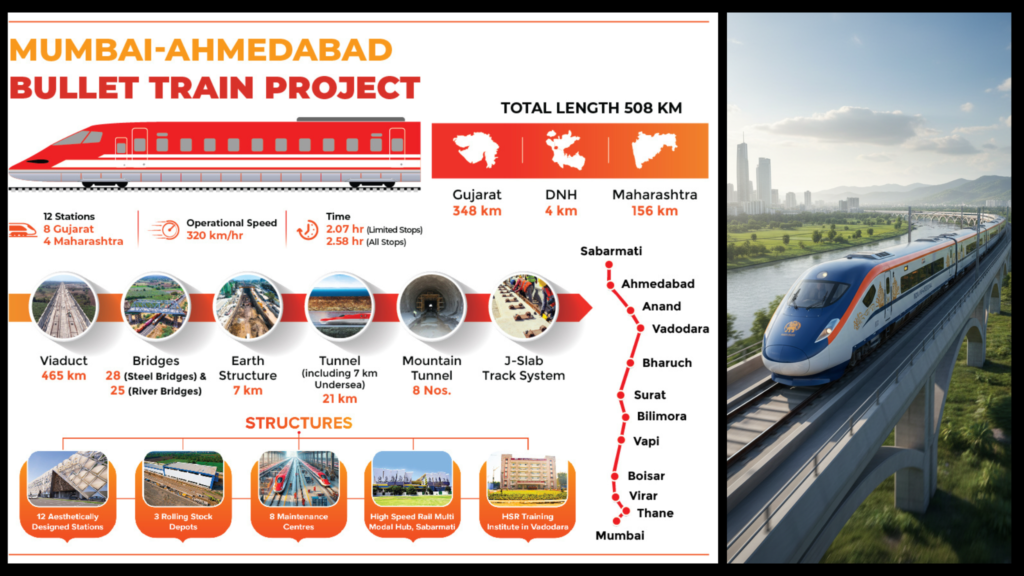
The Mumbai–Ahmedabad High-Speed Rail (MAHSR) corridor is redefining India’s idea of distance. This ₹1.1 lakh crore project will reduce travel time between the two major economic hubs from six hours to about two. According to Rajendra Prasad, Managing Director of the National High-Speed Rail Corporation (NHSRCL), “The project is not just about speed, but about transforming regional connectivity, job creation, and technology transfer.”
Linked Station development around Anand, Vadodara and Sabarmati is winning the attention of early investors. These stations are becoming new high-value nodes, in the same way as the Tokyo districts of Shinjuku and Shinagawa. Therefore, these stations are becoming the center of hospitality zones, logistic centers, and commercial areas, making MAHSR a strong economic line.
Moreover, progress in Gujarat is rapid. Over 260 km of viaducts are already complete, making it the fastest-moving section. In addition, India’s first under-sea rail tunnel near Thane Creek sets a new global engineering benchmark. The Sabarmati Multimodal Transport Hub is also reshaping the urban landscape by bringing high-speed rail, metro, BRT, and city rail to a single integrated location.
The high-speed rail isn’t just a project; it’s a corridor of opportunities — one that’s bridging not just cities but economies.
Metro Expansions: Shaping Smarter Urban Mobility
If the bullet train is set to redefine intercity travel, Gujarat’s expanding metro networks are reshaping the way its cities breathe, move, and grow. Ahmedabad Metro Phase II – linking Motera, Mahatma Mandir, and fast-developing GIFT City will ensure a smooth flow between residential areas and business areas and high-speed services and transport hubs. The alignment of transport infrastructure with urban planning is manifested in the increasing integration of transport infrastructure with urban planning according to S. S. Rathore, the Director of GMRC, when he says, “Metro-led development is transforming the way Ahmedabad grows and urban sprawl is being minimized”.
As the ride on Ahmedabad Metro is likely to reach 2.5 lakh daily by 2026 due to the blistering employment in GIFT City, the urban transport ecosystem in Gujarat is being developed as a reference point of efficient, sustainable, and future-ready transportation.
Green Energy Parks: Powering Progress, Sustaining the Future
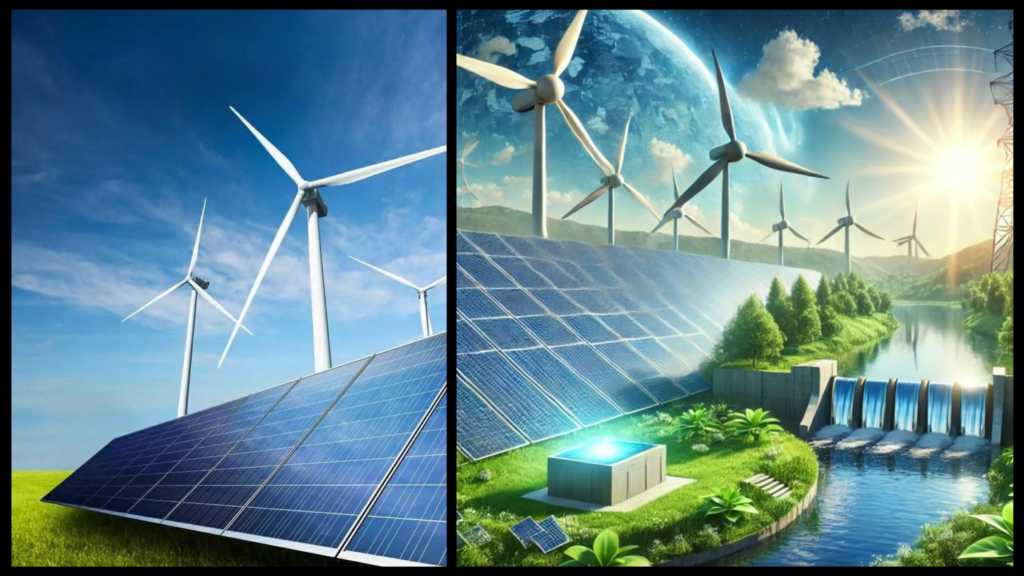
At the edge of the Rann of Kutch, the Khavda Renewable Energy Park is reshaping the future of clean power. The Khavda Renewable Energy Park, spread across 72,600 hectares, it will generate 30 GW of hybrid solar and wind energy, making it the largest renewable energy park worldwide. Adani Green is building a massive 10 GW solar-wind cluster, while NTPC REL has already commissioned 350 MW in its first block. Additionally, the park will supply clean energy to Dholera SIR’s green manufacturing clusters, EV units, and data centers.
As Chief Minister Bhupendra Patel aptly said, “Gujarat isn’t just generating power; it’s generating green opportunity. Our goal is to make every unit of energy a unit of progress — sustainable, scalable, and self-reliant.”
The Investment Multiplier: Infrastructure as an Economic Flywheel
Gujarat’s strength lies in its integrated vision. Transport, mobility, and energy projects are planned as a unified growth engine. A recent ASSOCHAM report estimates that the state may receive ₹12 lakh crore in infrastructure investment by 2030. These projects create several economic ripple effects. Engineers and workers gain steady employment. SMEs in steel, cement, and mobility receive new contracts. Real estate demand is rising near metro tracks and bullet train stations. Skill centers are also emerging near major construction zones. Moreover, land values near high-speed rail nodes have increased by 20–30%.
Gujarat 2030 — Fast, Connected & Green
Gujarat’s transformation is more than an infrastructure upgrade. It is a vision for India’s future. Faster travel, cleaner power, and advanced mobility systems are creating an environment where businesses can innovate and prosper. As Anand Mahindra says, “Infrastructure is the skeleton of prosperity — and Gujarat is building it with muscle and heart.”
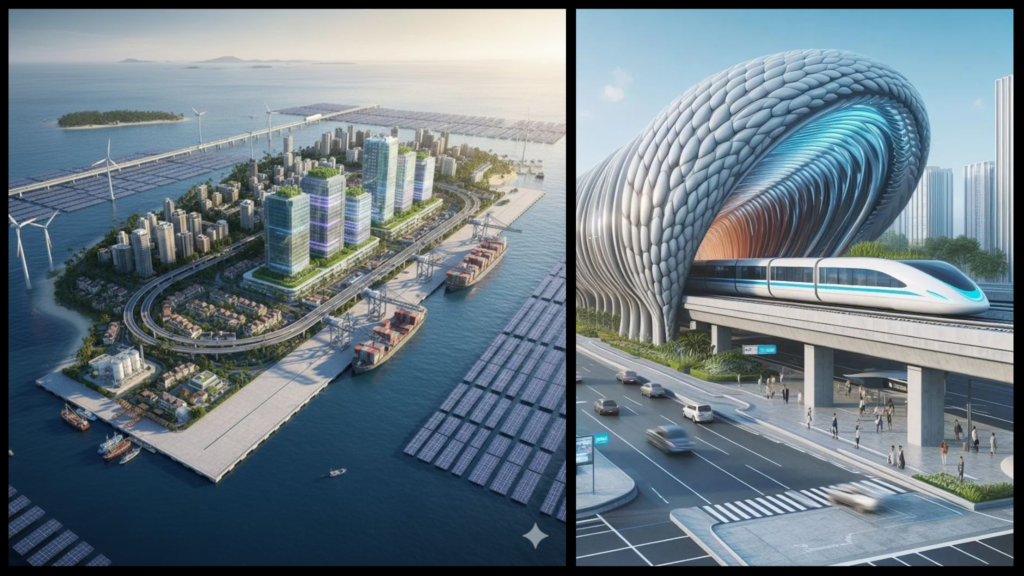
For investors, developers, and innovators, now is the perfect moment to explore Gujarat’s momentum. With unmatched opportunities in logistics, clean manufacturing, transit-oriented real estate, and next-generation industrial ecosystems, the state is shaping India’s next big growth chapter.
To dive deeper into Gujarat’s emerging possibilities and success stories, read more on Gujpreneur — your gateway to insights, opportunities, and transformative ideas that define the state’s new era of development.
Explore the opportunities. Engage with the vision. Be part of Gujarat’s next growth story.